Summarise this article with:
 ChatGPT
 Mistral
 Claude
 Perplexity
 Grok
Grok
A well-kept coffee machine simply makes better coffee — and knowing how to clean a Nespresso machine properly is the surest way to keep every espresso tasting fresh, rich and free of that stale, bitter edge. The good news is that Nespresso machines are designed to be taken apart and cleaned in minutes. With a bit of warm, soapy water and about ten minutes, you can have yours looking and brewing like new. This guide walks you through the full routine — from rinsing the removable parts to running a descaling cycle — for both Vertuo and Original models.
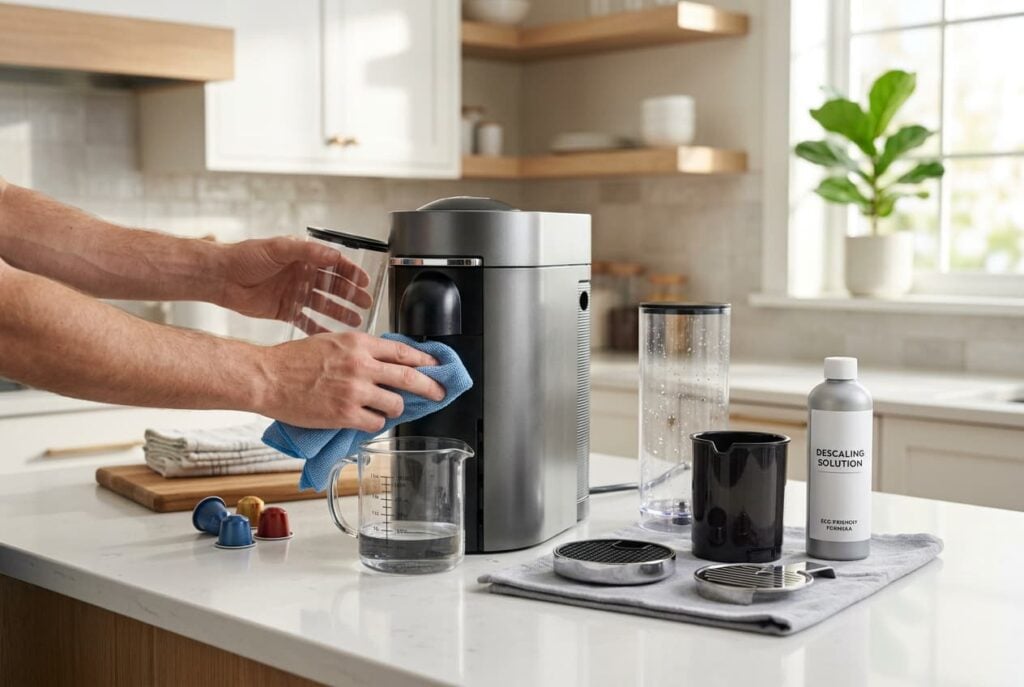
Why cleaning and descaling your Nespresso machine matters : Vertuo or De’Longhi
Every cup you brew leaves something behind: coffee oils splatter inside the capsule head, dregs collect in the drip tray, and heated hard water slowly leaves limescale in the internal pipes. Left unchecked, that build-up dulls the flavour, slows the pour and can eventually stop the machine heating properly.
There are really two jobs to stay on top of. The first is regular cleaning — washing the water tank, capsule container and drip tray so bacteria and coffee residue don’t accumulate. The second is descaling, which tackles the limescale and mineral deposits that hard water leaves inside. Do both on a sensible schedule and your machine will keep pouring beautifully for years.
How often should you clean a Nespresso machine?
As a rule of thumb, give the removable parts a proper wash every couple of weeks, and descale every three months (or every 300 capsules, whichever comes first). If you’re in a hard-water area or brewing several cups a day, lean towards the more frequent end.
| Task | How often |
|---|---|
| Empty & rinse drip tray + capsule container | Daily |
| Wipe the coffee outlet and exterior | Daily / after milky drinks |
| Wash water tank, tray and container in soapy water | Every 1–2 weeks |
| Rinse (water-only) cycle | Weekly |
| Full descale | Every 3 months / 300 capsules |
What you’ll need
You almost certainly have everything already:
- Washing-up liquid and a soft, non-abrasive cloth or sponge
- A container that holds at least 1 litre (to sit under the coffee outlet)
- Fresh water for rinsing
- A Nespresso descaling kit (or descaling solution) for the deep clean
How to clean a Nespresso machine: the 5-step method
Step 1: Switch off and remove the parts
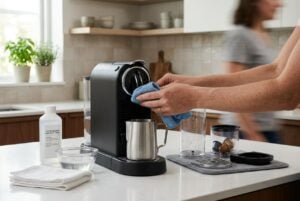
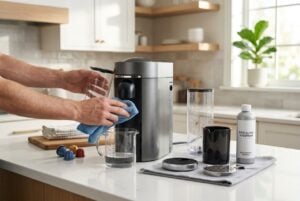
Always turn the machine off (and unplug it if you’re cleaning around the electrics) before you start. Lift out the water tank, eject any used capsule, and remove the capsule container, drip tray and cup support. Set them beside the sink ready to wash.
Step 2: Wash the water tank, capsule container and drip tray
Fill the sink with warm, soapy water and hand-wash each part with a soft cloth. Work into the corners of the water tank where a slimy film can form, and pour the cold dregs from the drip tray away first. Rinse everything thoroughly to remove any soapy residue and leave the parts to air-dry. Avoid the dishwasher and scented detergents — both can taint the taste of your next coffee.
Step 3: Wipe the coffee outlet and exterior
Coffee oils splatter around the capsule head and spout, so wipe these down with a damp, non-abrasive cloth. Give the body of the machine a wipe too. If you drink milk-based coffees, the coffee outlet needs this attention daily to stop residue building up.
Step 4: Run a water-only rinse cycle
Reassemble the clean, dry parts, refill the water tank with fresh water, and place your container under the coffee outlet. Run a rinse cycle with no capsule in the machine to flush old coffee grounds and oils out of the internal pipes. On most Original models you press the Lungo button and repeat two or three times; on Vertuo models you typically press the button three times quickly (within two seconds) to trigger the automatic cycle. Exact steps vary by model, so check your manual.
Step 5: Descale to remove limescale
This is the deep clean. Empty the drip tray and capsule container, then fill the tank with fresh water and one sachet of Nespresso descaling solution. Place a 1-litre container under the outlet, activate descaling mode, and let the solution run right through — then repeat the cycle with clean water to rinse the system thoroughly. Because this step is more involved and differs between Vertuo and Original models, we’ve broken it down button-by-button in our dedicated guide to descaling a Nespresso machine. The principle is the same one you’d use to descale a kettle — the solution dissolves the limescale that hard water leaves behind.
How to clean a Nespresso machine without a descaler
This is where Nespresso differs from other pod machines. You’ll see plenty of videos running white vinegar through a Nespresso, and can you descale a Nespresso with vinegar? is one of the most-asked questions online. The honest answer: Nespresso strongly advises against it. Vinegar and homemade acid mixes are difficult to measure precisely, and the wrong concentration can damage internal components — particularly the rubber gaskets, which may then start to leak.
If you have no descaling solution to hand, the safest route is to buy an official kit or a descaler made specifically for coffee machines. If you’d still rather use a natural acid, citric acid for cleaning is gentler and less pungent than vinegar and is the active ingredient in many branded descalers — just accept that it’s used at your own risk on a Nespresso. The same caution applies to white vinegar: fine for a kettle, but not Nespresso’s recommendation for their machines. For general worktop and surround cleaning, a little baking soda is a safer, machine-friendly helper.
Cleaning the milk frother (Aeroccino)
If your machine came with a milk frother, it needs cleaning after every use — milk residue turns quickly and can harbour bacteria. Unplug the frother and let it cool, remove the lid and detach the whisk and seal, then rinse all three under warm water. Wipe the inside with a damp, non-abrasive sponge (never submerge the Aeroccino itself), and dry everything with a clean cloth before reassembling. A quick rinse now saves a scrubbing session later.
Keeping your Nespresso in top condition
A few small habits make the bigger cleans far easier and protect your machine between descales:
- Use filtered or soft water to slow down limescale and mineral deposits
- Leave the capsule head open after brewing so the inside dries out
- Run a quick rinse cycle whenever you switch the machine on
- Store capsules somewhere cool and dry so they stay fresh
Treat your coffee machine like any other well-used kitchen appliance and it’ll reward you — the same little-and-often approach behind our favourite kitchen cleaning hacks keeps a Nespresso machine reliable, hygienic and ready for that first cup of the morning.
FAQ
How do I run a clean cycle on my Nespresso Vertuo or De’Longhi machine?
Empty the capsule container and drip tray, refit them, and place a container under the coffee outlet. Run the machine with fresh water and no capsule. On Original models this usually means pressing the Lungo button a few times; on Vertuo models, pressing the brew button three times rapidly triggers the automatic rinse cycle.
How to clean a Nespresso machine at home?
You don’t need anything special — warm, soapy water, a soft cloth and a container will do. Wash the water tank, capsule container and drip tray, wipe the coffee outlet and body, run a water-only rinse cycle, and descale every three months with an official solution.
What can I run through my Nespresso machine to clean it?
For everyday cleaning, run fresh water through as a rinse cycle. For a deep clean, run Nespresso descaling solution (or a coffee-machine-specific descaler) followed by two clean-water cycles to flush it out. Nespresso advises against vinegar for the internal system.
How do you self-clean a Nespresso machine?
Many Vertuo models have a built-in rinse/self-clean option: with the tank full of fresh water and a container under the spout, press the button three times quickly to run the cycle automatically. It flushes the internal pipes without a capsule in place.
Can you descale a Nespresso coffee machine with vinegar?
You physically can, but Nespresso strongly advises against it. Vinegar is hard to dilute accurately and can damage internal parts and rubber seals. An official descaling kit or a coffee-machine descaler is the safer choice.
Why is my Nespresso not making full cups?
A short or slow pour is usually a sign of limescale build-up restricting the water flow. A full descale normally restores the pressure and gets your cup sizes back to normal.