Summarise this article with:
 ChatGPT
 Mistral
 Claude
 Perplexity
 Grok
Grok
Store-bought cleaners promise fast results, but they often come with strong fumes, unnecessary chemicals and confusing labels. This is why more households are turning to homemade cleaning products. Done properly, they allow you to clean efficiently, control what goes into your home, and reduce exposure to aggressive substances — without compromising hygiene.
Professional cleaners do not improvise when making cleaning products. They rely on proven cleaning solutions, precise measurements and a clear understanding of what each ingredient does. Homemade does not mean random. When formulated correctly, natural cleaning products can act as natural disinfectant, natural degreaser and everyday surface cleaners, while fitting naturally into eco cleaning routines.
Eco cleaning
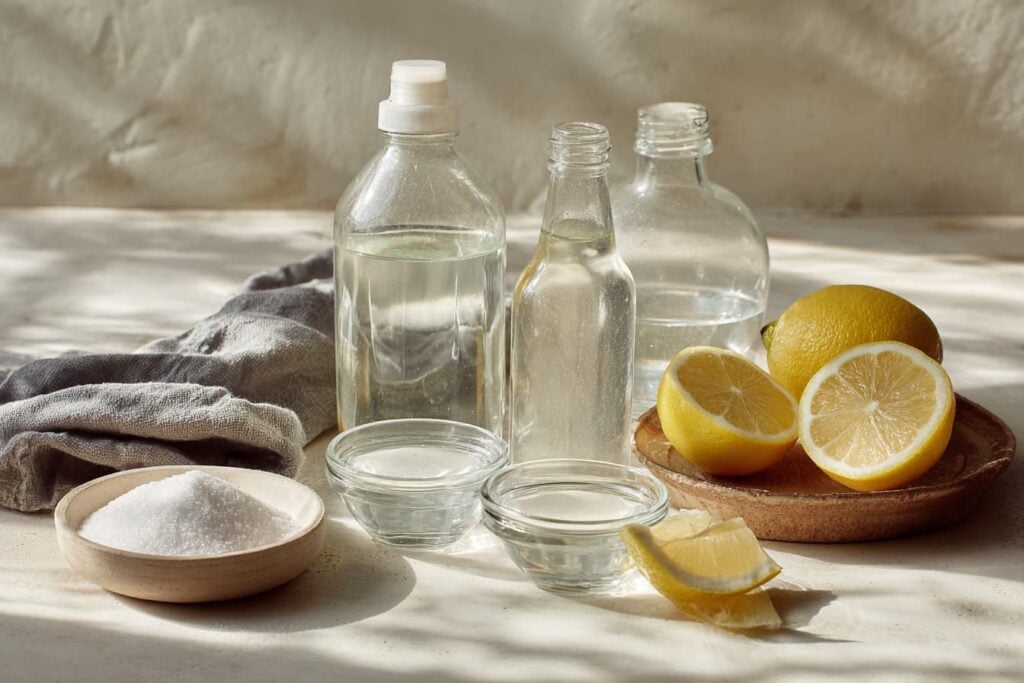
Eco cleaning is not about using fewer products — it is about using the right ones. Professional cleaners who adopt eco cleaning methods focus on efficiency, surface compatibility and safety. Homemade cleaning products are a cornerstone of eco cleaning because they reduce packaging, limit chemical exposure and rely on ingredients that are already familiar.
In practice, eco cleaning relies on a short list of reliable bases such as white vinegar, bicarbonate of soda and carefully selected essential oils. These ingredients allow cleaners to adapt one mixture to multiple tasks instead of storing dozens of bottles.
Non toxic cleaning products
Non toxic cleaning products are especially important in homes with children or pets. Homemade formulas allow full control over ingredients, making them a safer alternative when used correctly.
Professional cleaners avoid vague recipes. When making non toxic cleaning products, they follow clear ratios, use clean containers and label every spray bottle. This prevents misuse and ensures consistent results across different cleaning task.
Non toxic does not mean ineffective. Properly balanced cleaning solutions can remove grease, lift dirt and neutralise odours without aggressive chemicals.
Eco friendly cleaning products
Eco friendly cleaning products aim to reduce environmental impact without reducing cleaning performance. Homemade formulas achieve this by limiting synthetic additives and using biodegradable ingredients.
Many professional cleaners combine eco friendly cleaning products with targeted techniques such as mechanical agitation or dwell time. This approach reduces the need for stronger chemicals while maintaining hygiene standards.
Eco friendly cleaning products also fit naturally into routines that use natural cleaning products rather than single-use commercial formulas.
What are “clean cleaning products” ?
The idea of clean cleaning products is simple: minimal ingredients, clear purpose, no unnecessary additives. Homemade cleaning products align perfectly with this principle.
Professionals typically work with just a few core ingredients, mixing them into different mixture depending on the surface. This reduces storage clutter and avoids product overlap.
Organic cleaning products
Organic cleaning products rely on naturally derived ingredients with minimal processing. While not all homemade cleaning products are strictly organic, many can be adapted to meet organic standards by sourcing certified ingredients.
In professional practice, organic cleaning products are often reserved for food preparation areas, nurseries and sensitive environments, where ingredient transparency matters most.
Homemade cleaning solutions
Homemade cleaning solutions are the backbone of DIY cleaning. The key is consistency. Cleaners do not experiment on the fly; they follow tested recipes.
A typical homemade cleaning solution may include water, white vinegar or bicarbonate of soda, and optional essential oils. Each component has a role: water carries, vinegar breaks down minerals, bicarbonate of soda scrubs gently.
When preparing homemade cleaning solutions, professionals always:
- measure ingredients rather than estimating,
- mix in clean containers only,
- and test on an inconspicuous area before full use.
Homemade cleaning spray
A homemade cleaning spray is one of the most versatile tools in eco cleaning. It is used for countertops, bathroom surfaces and light degreasing.
Professionals prepare a homemade cleaning spray in a labelled spray bottle, never reusing containers that previously held chemicals. This avoids dangerous reactions and ensures safety.
Homemade cleaning spray formulas often complement other methods such as cleaning with lemon or salt water, depending on the surface.
Homemade bathroom cleaner
Bathrooms require targeted action against limescale, soap scum and bacteria. A homemade bathroom cleaner is typically acid-based, relying on white vinegar or citric acid.
Professional cleaners adjust concentration depending on surface sensitivity. For example, enamel and ceramic tolerate stronger solutions, while natural stone does not.
When using a homemade bathroom cleaner, cleaners focus on dwell time rather than scrubbing force, preserving surfaces over time.
Chemical free cleaning products
Chemical free cleaning products appeal to households aiming to reduce exposure to synthetic substances. While all matter is technically chemical, the term refers here to avoiding industrial additives.
Homemade cleaning products meet this goal when they rely on food-grade or naturally derived ingredients. However, professionals still treat them with respect, store them safely and avoid mixing incompatible substances.
Make homemade cleaning products
To make homemade cleaning products effectively, structure matters more than creativity. Cleaners follow repeatable steps rather than inventing new recipes for each task.
When making products, professionals always:
- choose ingredients based on the cleaning task,
- prepare only small batches to maintain freshness,
- and note usage limits to avoid surface damage.
This disciplined approach ensures reliability and safety.
Natural disinfectant
A natural disinfectant does not have to be aggressive to be effective. Certain homemade cleaning products reduce microbial load sufficiently for domestic environments when used correctly.
Vinegar-based solutions and hydrogen peroxide (used separately, never mixed) are commonly used as natural disinfectant options for non-porous surfaces.
Professionals never claim sterilisation from homemade products. They use them for routine hygiene, not medical-grade disinfection.
Cleaner using vinegar
A cleaner using vinegar is one of the most common homemade cleaning products. Vinegar dissolves mineral deposits, cuts soap residue and neutralises odours.
Professional cleaners rely on vinegar for glass, taps and tiles but avoid it on natural stone or delicate finishes. In those cases, alternatives such as citric acid for cleaning may be safer.
Natural degreaser
A natural degreaser is essential for kitchens. Bicarbonate of soda combined with warm water creates a mild abrasive that lifts grease without scratching.
Professionals often pair a natural degreaser with mechanical action rather than stronger chemistry. This protects surfaces and reduces residue.
Essential oil cleaning products
Essential oil cleaning products are used primarily for fragrance and mild antibacterial properties. Cleaners choose oils carefully, avoiding overuse.
Essential oils and cleaning go hand in hand when used sparingly. Only a few drops are added per litre of solution to prevent surface damage and strong odours.
How do you make your own cleaning products?
You make your own cleaning products by combining water with targeted active ingredients such as white vinegar, bicarbonate of soda or soap-based elements, depending on the task. Professional cleaners always select ingredients based on surface type and soil level, not convenience.
What is the best homemade cleaning solution?
There is no single best solution. The best homemade cleaning solution depends on the job. Vinegar-based solutions work best for limescale, while bicarbonate of soda works better for grease. Effective cleaning relies on matching the solution to the surface.
How do you make homemade sterilizing solution?
Homemade products can reduce germs but do not replace professional disinfectants. A vinegar-based solution or hydrogen peroxide used separately can act as a natural disinfectant for everyday hygiene, provided surfaces are non-porous.
What should you not mix vinegar with for cleaning?
Vinegar should never be mixed with bleach or hydrogen peroxide. Mixing creates harmful reactions. Professional cleaners always store products separately and label containers clearly.
How do you make homemade cleaning products that smell good?
To improve scent, professionals add small amounts of essential oils such as lemon or tea tree. This aligns with essential oils and cleaning best practices and avoids overpowering fragrances.
Common homemade cleaning products
Professionals rely on clear references rather than guesswork. For example, homemade cleaning products are typically used as follows:
| Product type | Main ingredients | Best use |
|---|---|---|
| All-purpose spray | Water, white vinegar | Surfaces, glass |
| Scrub paste | Bicarbonate of soda, water | Sinks, ovens |
| Bathroom cleaner | Vinegar or citric acid | Limescale |
Comparison: homemade vs commercial products
Homemade cleaning products are not always interchangeable with store-bought ones:
| Criteria | Homemade cleaning products | Commercial products |
|---|---|---|
| Ingredient control | Full | Limited |
| Fragrance | Customisable | Fixed |
| Strength | Moderate | Often stronger |
FAQ: professional cleaner answers
Are homemade cleaning products really effective?
Yes, when matched correctly to the task and used consistently.
Do homemade products replace everything?
No. They are ideal for routine cleaning but not for specialist sanitation.
Are homemade products safer?
They reduce exposure but still require proper handling.
Final professional advice
Homemade cleaning products work best when treated with the same discipline as professional tools. Choose the right ingredients, respect surfaces, and avoid unsafe mixtures. With the right approach, eco cleaning becomes both practical and reliable — without unnecessary chemicals.