Summarise this article with:
 ChatGPT
 Mistral
 Claude
 Perplexity
 Grok
Grok
DIY cleaning agents are everywhere — from kitchen cupboards to social media feeds. But do they genuinely clean, degrease and disinfect, or are they just feel-good mixtures? When used correctly, the right natural cleaning products can tackle grease, limescale and everyday grime efficiently — without overloading your home with harsh fumes.
Many households across the UK are choosing homemade cleaning products to reduce packaging waste, control ingredients and save money. The key is understanding what works, where it works, and what to avoid. Let us break it down like a professional cleaner would.
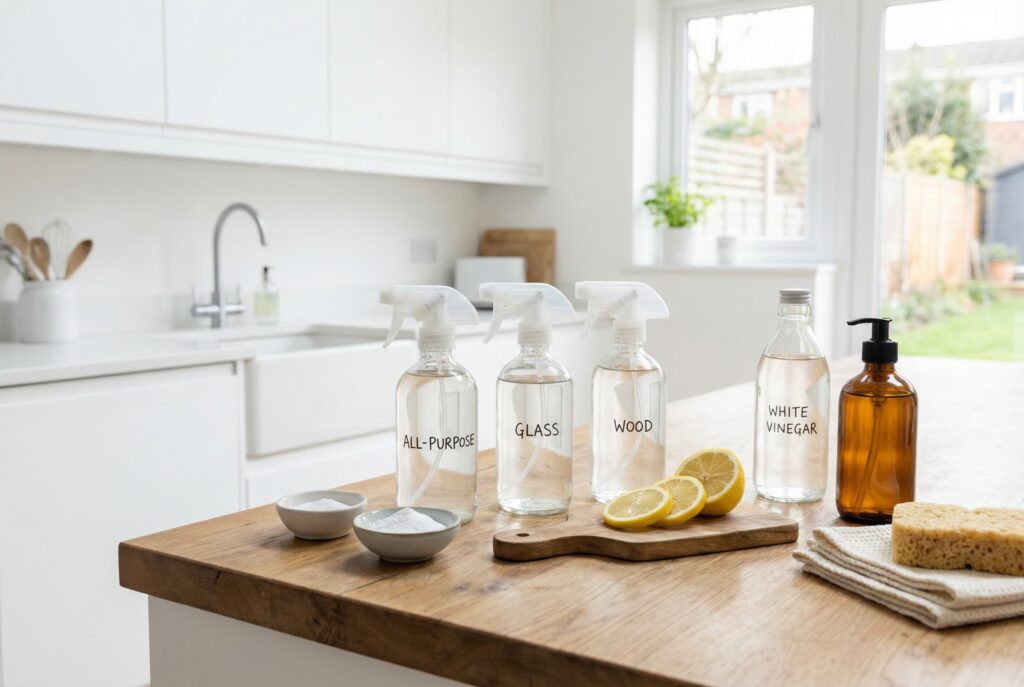
Natural Cleaning Products Recipes
Natural cleaning products rely on simple, active ingredients such as vinegar, bicarbonate of soda, lemon juice and castile soap. These are not magic solutions — they work because of their chemistry.
Vinegar (acetic acid) dissolves limescale and soap scum. Bicarbonate of soda acts as a mild abrasive and odour neutraliser. Castile soap lifts grease. Lemon juice adds mild acidity and freshness.
In professional cleaning, we often combine commercial products with targeted natural cleaning products for maintenance cleaning. The advantage of natural cleaning products UK households appreciate most? Control over ingredients and fewer synthetic fragrances lingering in the air.
However, remember:
- Vinegar is not suitable for natural stone (marble, granite).
- Bicarbonate of soda is abrasive on delicate finishes.
- Essential oils add scent but do not disinfect.
Used wisely, natural cleaning products can handle everyday maintenance with confidence.
Homemade Cleaning Products
Switching to homemade cleaning products means understanding dilution and purpose. Throwing random ingredients into a spray bottle will not give you the best DIY cleaning agents.
Professional rule: one product, one purpose.
You will typically need:
- A labelled spray bottle
- A measuring jug
- Hot (not boiling) water
- A soft cloth
Well-prepared homemade cleaning products UK households use most often include multi-surface sprays, bathroom descalers and degreasers. If you are unsure where to start, reviewing effective DIY cleaning products recipes helps you avoid damaging surfaces.
For heavy grease in kitchens, a proper homemade degreaser based on castile soap works better than vinegar alone. For glass, skip soap entirely and use a diluted acidic solution.
Best Natural Cleaning Products in the UK
In the UK, hard water is a major issue. This means limescale builds up quickly in kettles, taps and shower screens. That is where natural cleaning products UK homes rely on — especially vinegar-based solutions.
A simple cleaner using vinegar and hot water can remove early limescale. For tougher build-up, allow the solution to sit for 30–60 minutes before scrubbing with a soft cloth.
Many people looking for best natural cleaning products options combine vinegar with a few drops of tea tree oil. While this adds antibacterial properties, remember that drops of essential oil do not replace proper disinfectants where hygiene is critical.
For bathroom upkeep, explore targeted homemade cleaning products for bathroom tasks instead of using a single mix everywhere.
Homemade Cleaning Spray
A well-balanced homemade cleaning spray is the backbone of most DIY cleaning agents.
Here is a reliable multi-surface recipe:
Multi-surface spray (not for stone surfaces)
- 250 ml white vinegar
- 250 ml hot water
- 5 drops of essential oil (optional)
Shake gently before use. Spray lightly and wipe with a soft cloth.
For grease-prone surfaces, use a castile soap version instead:
- 1 tablespoon liquid castile soap
- 500 ml hot water
This functions as a light homemade degreaser and is suitable for sealed worktops and cupboard doors.
If you are exploring a floor cleaner solution homemade, increase dilution and avoid over-wetting wooden floors. Damp — never soaked — is the rule.
How to Make your Own Cleaning Products ?
When you make your own cleaning products, precision matters. Incorrect ratios reduce effectiveness or leave streaks.
Below is a practical comparison table used by professional cleaners:
| Cleaning Task | Ingredient Base | Dilution | Best For | Avoid On |
|---|---|---|---|---|
| Limescale removal | Vinegar | 1:1 with water | Taps, shower glass | Marble, granite |
| Light degreasing | Castile soap | 1 tbsp / 500 ml | Kitchen surfaces | Untreated wood |
| Odour removal | Bicarbonate of soda | Dry use | Carpets, bins | Wet polishing |
| Glass cleaning | Vinegar | 1:3 with water | Windows, mirrors | Stone |
Understanding these ratios helps you create best natural cleaning products at home rather than ineffective mixtures.
Organic Cleaning Products
The term organic cleaning products is often confused with natural. Organic refers to how ingredients are grown, not necessarily how well they clean.
Many shop-bought organic cleaning products still contain surfactants. In contrast, homemade cleaning products rely on simpler chemistry.
If sustainability is your goal, combining natural cleaning products UK practices with reusable cloths and refillable spray bottles has more impact than simply switching labels.
Homemade Degreaser
Grease requires surfactants. Vinegar alone will not cut through thick cooking residue.
A proper homemade degreaser should contain soap. For stronger kitchen build-up:
- 1 tablespoon castile soap
- 1 teaspoon bicarbonate of soda
- 500 ml hot water
Apply with a soft cloth. Leave for five minutes. Rinse thoroughly.
For ovens or stubborn hobs, a bicarbonate paste works well. Spread, leave for several hours, then wipe away. If grease is baked on, consider reading about homemade dishwasher cleaner maintenance to prevent internal build-up affecting performance.
How to Make a Homemade Cleaner Using Vinegar ?
A cleaner using vinegar is ideal for limescale and soap scum. It works particularly well as part of homemade cleaning products for bathroom routines.
Use it for:
- Shower screens
- Chrome taps
- Toilet bowls (for mineral stains)
Do not mix vinegar with bicarbonate inside a closed bottle. The fizz looks impressive but neutralises the cleaning power.
For grout lines, combine a homemade grout cleaner approach using bicarbonate paste first, then rinse with a mild cleaner using vinegar solution.
How to Make Homemade Cleaning Products for Bathroom ?
Bathrooms benefit most from DIY cleaning agents, especially in hard water areas.
Effective routine:
- Spray vinegar solution on shower glass after use.
- Use bicarbonate paste weekly on grout.
- Apply castile soap solution on tiles and rinse.
If tackling stubborn grout, a dedicated homemade grout cleaner paste left for 30 minutes improves results.
For laundry hygiene, some households prefer homemade laundry detergent , but ensure proper rinsing to avoid residue build-up in washing machines.
DIY Cleaning Products Recipes
Reliable DIY cleaning products recipes are simple, not complicated. If a recipe includes ten ingredients, it is rarely more effective.
Core combinations to remember:
- Vinegar + water = limescale removal
- Castile soap + water = grease removal
- Bicarbonate (dry or paste) = abrasion & odour control
When looking for the best DIY cleaning agents, effectiveness always depends on contact time and correct surface choice.
Do Baking Soda and Vinegar Actually Clean ?
Yes — but not together in the way most people think. Bicarbonate of soda cleans through abrasion and odour neutralisation. Vinegar dissolves mineral deposits.
When mixed, they neutralise each other. The fizz helps lift debris mechanically, but the cleaning chemistry weakens. For best results, use them separately and rinse in between.
How do you make homemade cleaning agents?
Start with one purpose. Choose the right base ingredient. Dilute correctly. Label clearly.
For example, to create a homemade window cleaner, dilute vinegar 1:3 with water and polish dry with a soft cloth. To create a floor cleaner solution homemade , reduce soap quantity and avoid over-wetting.
Always store DIY cleaning agents in a cool, dark cupboard and use within one month.
How can you Make your Own Cleaning Products to Sell ?
If you plan to sell homemade cleaning products in the UK, regulations apply. You must:
- Comply with UK chemical safety standards
- Provide ingredient labelling
- Conduct safety assessments
Even organic cleaning products require proper documentation. Homemade does not mean unregulated.
What is the Best Homemade Cleaning Solution ?
There is no single best solution. The best natural cleaning products are task-specific.
For limescale: diluted vinegar.
For grease: castile soap solution.
For odours: bicarbonate of soda.
Professional cleaning always matches the product to the problem.