Résumer cet article avec :
 ChatGPT
 Mistral
 Claude
 Perplexity
 Grok
Grok
Your dishwasher is supposed to clean your dishes. Yet over time, it becomes one of the dirtiest appliances in the kitchen. Food debris, grease, mineral deposits, and detergent residue build up in the bottom of the dishwasher, inside the spray arms, around the rubber gasket, and even behind the dishwasher door seal.
The result? A smelly dishwasher, cloudy glasses, poor washing performance, and sometimes even drainage issues.
The good news? A properly formulated homemade dishwasher cleaner can restore performance and hygiene — if you follow the right process. Let us break it down clearly, step by step, with practical advice you can apply immediately.
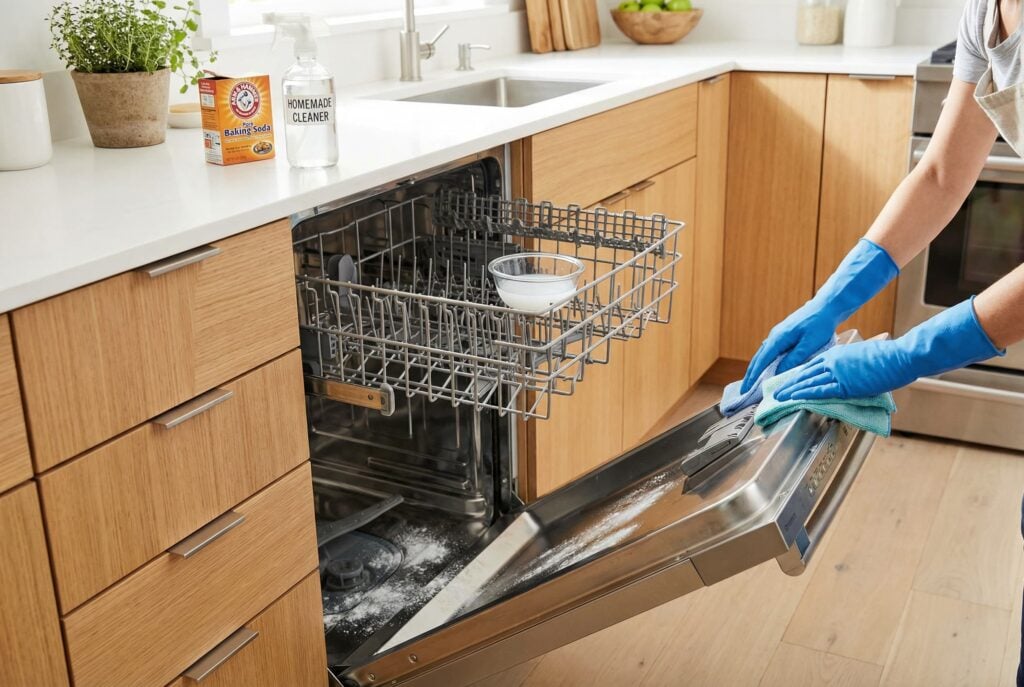
Cleaning dishwasher with vinegar
Using white vinegar is one of the most effective ways to clean dishwasher vinegar style and dissolve limescale.
Vinegar contains acetic acid, which helps break down mineral deposits caused by hard water. It also reduces grease and neutralises odours inside the dishwasher.
Step-by-step vinegar cleaning cycle
- Make sure you have an empty dishwasher.
- Remove visible debris from the bottom of the dishwasher.
- Place a cup of white vinegar in a dishwasher-safe bowl on the top rack.
- Run a hot cycle without detergent.
The heat distributes the acetic acid throughout the internal parts, including the spray arms and filter.
This method is particularly useful if you notice white scaling or dull residue on your dishes.
Cleaning the dishwasher
Regular cleaning the dishwasher prevents deeper problems.
At least once a month, inspect:
- The filter
- The spray arms
- The rubber gasket
- The dishwasher door edges
- The detergent aid compartment
Use an old toothbrush to scrub tight areas. Wear gloves if you have sensitive skin, especially when dealing with concentrated vinegar or descaling agents.
If grime persists, a targeted deep clean is necessary.
Cleaning your dishwasher with vinegar and baking soda
Many people combine vinegar and baking soda, but timing matters.
To clean the dishwasher with vinegar and baking soda properly:
- Run the vinegar cycle first.
- Sprinkle a cup of baking soda across the bottom of the dishwasher.
- Run a short hot cycle.
The baking soda helps neutralise odours and remove soap scum. However, mixing vinegar and baking soda at the same time reduces their effectiveness — they neutralise each other.
This two-step process improves freshness and reduces lingering smells in a smelly dishwasher.
Non toxic dishwasher detergent
If you want a non toxic dishwasher detergent, focus on safe, minimal ingredients.
A basic powdered dishwasher detergent recipe may include:
- Washing soda
- Citric acid
- Fine salt
Some traditional formulas include borax, but its use is debated. Always research local safety recommendations before using borax in your dishwasher detergent.
If your household prioritises natural cleaning products , switching to a homemade formula reduces exposure to certain synthetic additives found in some commercial dishwasher cleaners.
Dishwasher detergent
Your dishwasher detergent affects performance and residue.
Too much detergent can create buildup in the internal parts, leading to odours and poor rinsing.
If you prefer DIY approaches, explore a balanced recipe rather than overusing detergent. The key is precise measurement.
Many households interested in diy cleaning agents also adopt similar principles across the home — for example using a floor cleaner solution homemade for hard floors or making a homemade window cleaner for streak-free glass. The same rule applies: correct dosage ensures proper cleaning without buildup.
Best homemade dishwasher cleaner
The best homemade dishwasher cleaner for maintenance is citric acid-based.
Citric acid cleaning cycle
- Remove racks if heavily soiled.
- Add 2–3 tablespoons of citric acid directly into the detergent compartment.
- Run a hot cycle.
Citric acid effectively dissolves mineral deposits from hard water without the strong smell of vinegar.
This method is particularly effective if you need to descale dishwasher components thoroughly.
Cleaning your dishwasher with baking soda
If odour is your main issue, cleaning with baking soda alone can help.
Sprinkle a thin layer across the base of an empty dishwasher. Run a short hot cycle.
Baking soda neutralises odours but does not remove heavy scale. Use it as part of routine maintenance rather than a full deep clean solution.
Best way to clean a dishwasher
The best way to clean a dishwasher combines manual cleaning and a hot cleaning cycle.
Follow this structured step routine:
- Remove racks.
- Wash racks in the sink with warm soapy water.
- Clean the filter thoroughly.
- Scrub the rubber gasket with vinegar.
- Wipe the dishwasher door interior.
- Run a descaling cycle.
This complete process ensures both visible and hidden areas are addressed.
Natural dishwasher tablets
If you prefer natural dishwasher tablets, you can make your own.
Basic homemade tablets
In a mixing bowl, combine:
- 1 cup washing soda
- 1 cup baking soda
- ½ cup citric acid
- A few drops water to bind
Press into silicone moulds. Let dry in a safe container for 24 hours.
These dishwasher tablets homemade reduce reliance on synthetic fragrances and may suit households seeking chemical free dishwasher tablets.
However, performance may vary depending on hard water levels.
Deep clean dishwasher cleaner
A proper deep clean dishwasher cleaner session is necessary every 2–3 months.
This includes:
- Removing and soaking the filter
- Clearing blockages in the spray arms
- Cleaning the detergent aid compartment
- Inspecting the drain
If you leave residue for too long, grease combines with limescale and forms hardened buildup that requires more effort to remove.
Dishwasher tablet alternatives
A simple dishwasher tablet alternative is powdered detergent stored in a sealed jar.
Use 1 tablespoon per wash cycle. Avoid overfilling the detergent compartment.
Some people experiment with unconventional alternatives like crushed bath products. Avoid using items such as bath bombs — they contain oils that can clog the internal parts of your dishwasher.
Homemade dishwasher detergent recipe
Here is a balanced homemade dishwasher detergent recipe suitable for moderate water hardness:
| Ingredient | Quantity | Purpose |
|---|---|---|
| Washing soda | 1 cup | Grease removal |
| Citric acid | ½ cup | Descaling |
| Fine salt | ½ cup | Softens water |
| Baking soda | ½ cup | Deodorising |
Store in a dry, airtight container.
If you are already making a homemade laundry detergent, you will recognise the importance of precise measurement. The same discipline applies here.
Homemade dishwasher tables
Homemade dishwasher tablets should be stored in a moisture-free environment.
Humidity reduces effectiveness and causes clumping.
Always label clearly and keep out of reach of children.
Cleaning the dishwasher naturally
If you prefer cleaning the dishwasher naturally, alternate between vinegar cycles and citric acid cycles.
For stainless steel interiors, avoid abrasive pads. Instead, wipe with diluted vinegar using a soft cloth. This works well as a mild stainless steel cleaner.
Households already using homemade cleaning products for bathroom often find that similar descaling principles apply to kitchen appliances.
Chemical free dishwasher tablets
When looking for chemical free dishwasher tablets, check ingredient transparency.
Avoid products with strong artificial fragrances. Focus on simple mineral-based components.
However, remember that “chemical free” is a marketing term — even vinegar and citric acid are chemicals. The key is selecting safe, minimal formulas.
Descale dishwasher
To descale dishwasher components effectively, citric acid is usually stronger than vinegar.
Run an empty hot cycle with 2–3 tablespoons of citric acid in the detergent compartment.
If limescale persists, repeat once.
Descaling is particularly important in regions with hard water.
Homemade dishwasher cleaner with citric acid
A homemade dishwasher cleaner with citric acid solution is ideal for scale removal without vinegar odour.
Citric acid breaks down calcium buildup efficiently while remaining relatively gentle on components.
It also leaves less lingering smell compared to vinegar.
Homemade dishwasher cleaner without vinegar
If you prefer a homemade dishwasher cleaner without vinegar, use citric acid alone or washing soda for grease removal.
This approach suits households sensitive to vinegar smells.
Homemade dishwasher cleaner for hard water
A homemade dishwasher cleaner for hard water must prioritise descaling.
Increase citric acid slightly and run regular maintenance cycles.
Hard water causes frequent mineral deposits, cloudy glasses, and buildup in the spray arms.
Homemade dishwasher drain cleaner
For a homemade dishwasher drain cleaner, remove and rinse the filter manually first.
Pour hot water carefully into the drain area. If necessary, use baking soda followed by vinegar in the drain (not during a full wash cycle) and flush with hot water after 15 minutes.
Homemade dishwasher cleaner for dishes
A homemade dishwasher cleaner for dishes should balance grease removal and descaling without leaving residue.
If dishes appear cloudy after switching to DIY detergent, adjust dosage or increase rinse aid.
Vegan homemade dishwasher cleaner
A homemade dishwasher cleaner vegan formula simply avoids animal-derived additives.
Most mineral-based DIY recipes already qualify as vegan.
Homemade lemon dishwasher cleaner
A homemade lemon dishwasher cleaner can be created by adding lemon juice to a wash cycle. However, lemon is less concentrated than citric acid powder and may not remove heavy scale effectively.
Homemade stainless steel dishwasher cleaner
For exterior care, use diluted vinegar as a gentle stainless steel cleaner.
Wipe with a soft cloth and dry immediately to avoid streaks.
FAQ
How do you clean a dishwasher?
Remove debris, clean the filter, wipe seals, and run a hot cleaning cycle using vinegar or citric acid in an empty dishwasher.
How do you clean a dishwasher with vinegar?
Place a cup of white vinegar on the top rack of an empty dishwasher and run a hot cycle.
How do you clean a dishwasher with vinegar and baking soda?
Run a vinegar cycle first. Then sprinkle a cup of baking soda in the bottom and run a short hot cycle.
How often should you clean your dishwasher?
Once a month for maintenance. Deep clean every 2–3 months.
How do you use dishwasher cleaner?
Add the cleaner to the detergent compartment or place it inside as directed. Always run the cycle empty.
How do you clean a dishwasher with baking soda?
Sprinkle baking soda across the bottom of the dishwasher and run a short hot cycle.
How do you descale a dishwasher?
Use citric acid in the detergent compartment and run a hot cycle.
How do you clean the inside of a dishwasher?
Remove racks, clean filter, scrub spray arms, wipe the rubber gasket, and run a cleaning cycle.
How do you deep clean a dishwasher?
Combine manual scrubbing of internal parts with a descaling cycle using citric acid.
What should you use to clean a dishwasher?
Use white vinegar for light scale, citric acid for heavy scale, and baking soda for odour control.
How do you make a homemade dishwasher cleaner?
Combine washing soda, citric acid, salt, and baking soda. Store in an airtight container.
What is a homemade dishwasher cleaner?
It is a DIY formula using simple mineral-based ingredients to clean and descale a dishwasher.
What is the best homemade dishwasher cleaner?
Citric acid-based formulas offer the strongest descaling performance for most households.
A properly maintained dishwasher lasts longer, cleans better, and smells fresh. With the right recipe, correct process, and regular maintenance, your homemade dishwasher cleaner routine can match — and sometimes outperform — many commercial dishwasher cleaners.