Summarise this article with:
 ChatGPT
 Mistral
 Claude
 Perplexity
 Grok
Grok
Apple cider vinegar has a reputation that divides households. Some swear by it for natural cleaning, others find it disappointing compared to white vinegar. The truth sits somewhere in between. Used correctly, apple cider vinegar for cleaning can solve specific everyday problems — odours, light limescale, greasy residues — while remaining gentler on certain surfaces.
Because it is less acidic than distilled white vinegar, apple cider vinegar behaves differently. That difference matters. Understanding where it works, how to dilute it properly and when to switch to another solution saves time, avoids damage and delivers cleaner results without harsh chemicals.
Let us break it down like a professional cleaner would.
What is apple cider vinegar and why is it used for cleaning?
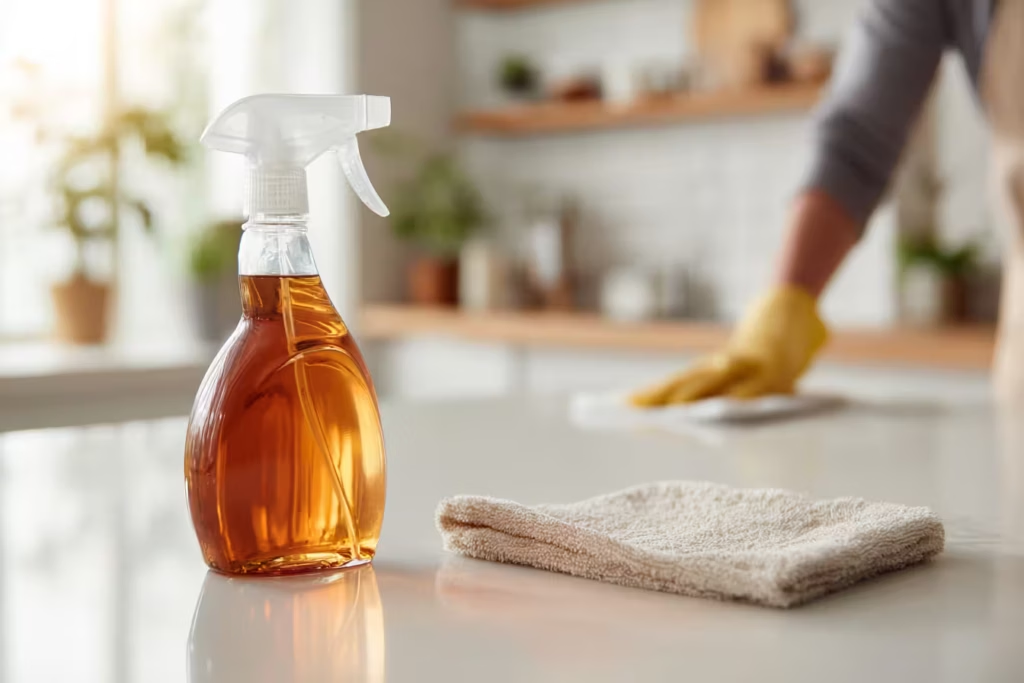
Apple cider vinegar is produced by fermenting apple juice until its sugars convert into acetic acid. That acid content — usually around 5% — gives it mild descaling and degreasing power. Compared with white vinegar, its acid level is softer and its smell is fruitier, which many households find easier to tolerate.
In practical terms, apple cider vinegar for cleaning is useful when you need a milder acidity for routine maintenance rather than heavy-duty descaling. It is also popular for deodorising fabrics and surfaces where harsh products are not ideal.
Because it is food-grade, it appeals to those looking to reduce harsh chemicals at home — but “natural” does not automatically mean suitable for every surface.
How do you clean with apple cider vinegar?
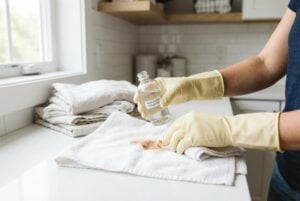
Cleaning effectively with apple cider vinegar always starts with dilution. Using it neat rarely improves results and increases the risk of marks or residue.
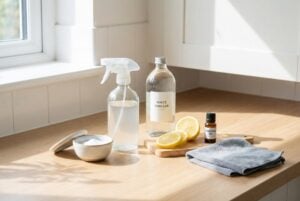
In most cases, professionals recommend a simple mix made with warm water. For daily cleaning, combine equal parts liquid in a spray bottle, shake gently and apply with a soft cloth. This approach mirrors methods often used to clean with white wine vinegar , but with a slightly gentler finish.
Inside a paragraph, this solution can be enhanced with:
- a few drops of essential oils for scent (never for extra cleaning power),
- a microfibre cloth instead of paper towel to avoid streaks,
- warm water to help dissolve grease faster.
This diluted solution works best on sealed surfaces, light dirt and fresh marks.
What can you clean with apple cider vinegar?
Apple cider vinegar has a narrower but still useful range of uses around the house. It performs best where odour control, mild grease removal and light mineral deposits are involved.
Professionally, it is often used on:
- sealed kitchen worktops after cooking,
- bins and food waste caddies to neutralise smells,
- inside kettles with light limescale (with caution),
- bathroom fittings with early hard water stains,
- washing machine drawers for deodorising cycles.
It is also helpful when alternating products, especially if you already rely on vinegar cleaners but want a less aggressive option between deeper cleans.
Apple cider vinegar for cleaning floors: is it a good idea?
Using apple cider vinegar on floors depends entirely on the floor type. When diluted correctly, it can be used on sealed hard floors, but never on untreated or porous materials.
For sealed tiles or vinyl, a diluted solution can be mopped lightly. This method is sometimes compared with using vinegar to clean floors , but apple cider vinegar leaves a softer finish and a less sharp smell.
Inside a paragraph, professionals usually recommend:
- one cup of apple cider vinegar in 5 litres of warm water,
- a well-wrung mop to avoid excess moisture,
- no rinsing unless residue appears.
Never use apple cider vinegar on:
- natural stone surfaces (marble, granite, slate),
- waxed wood,
- unsealed laminate.
The acid can etch or dull these finishes permanently.
Apple cider vinegar vs white vinegar for cleaning: what is the difference?
This is where confusion often begins. Many people assume all vinegars clean the same way. They do not.
Apple cider vinegar and white vinegar differ in acidity, colour and residue. White vinegar is clearer and slightly stronger, making it more effective for limescale and mould.
This difference explains why people asking is distilled vinegar the same as white vinegar are often surprised by the answer. Distilled white vinegar is filtered, colourless and more predictable for cleaning than apple cider vinegar.
Comparison table: apple cider vinegar vs white vinegar
| Property | Apple cider vinegar | White vinegar |
|---|---|---|
| Acidity | ~5% | 5–7% |
| Colour | Amber | Clear |
| Smell | Fruity | Sharp |
| Best for | Odours, light grease | Limescale, mould |
| Residue risk | Medium | Low |
This table highlights why professionals still reach for white vinegar in bathrooms and kitchens when performance matters more than scent.
Is apple cider vinegar good for mould removal?
Short answer: not really. Mould requires stronger acidity and longer contact time. While apple cider vinegar can slow surface growth, it does not penetrate porous materials effectively.
For bathrooms, professionals still rely on white vinegar for mould, which explains why many guides focus on white vinegar for mould rather than apple cider vinegar.
Inside a paragraph, it is important to note:
- apple cider vinegar may remove surface discolouration,
- spores can remain beneath the surface,
- improper treatment allows regrowth within weeks.
For persistent mould, switch to white vinegar or professional-grade solutions and ensure proper ventilation.
Can you use distilled malt vinegar for cleaning instead?
This question appears frequently and deserves a clear answer. Can you use distilled malt vinegar for cleaning ? Technically yes, but it is rarely ideal.
Malt vinegar contains residues and sugars that can leave sticky films behind. It also smells stronger and lingers longer than apple cider or white vinegar. While it can be used in a pinch, it is not recommended for regular cleaning.
Compared to apple cider vinegar for cleaning, malt vinegar:
- leaves more residue,
- attracts insects if not rinsed,
- is harder to neutralise on surfaces.
Professionals generally avoid it unless no alternative is available.
Cleaning bathtubs with apple cider vinegar and baking soda
Bathrooms are where vinegar myths multiply. Many people attempt cleaning bathtub with bicarbonate of soda, vinegar, and hot water, expecting a dramatic reaction to “clean everything”.
The reality is more measured. Vinegar (acid) and baking soda (base) neutralise each other. The fizz helps lift dirt mechanically, not chemically.
Inside a paragraph, a safer method looks like this:
- apply baking soda paste to stained areas,
- scrub gently,
- rinse,
- follow with diluted apple cider vinegar to dissolve remaining soap residue.
Never mix vinegar with bleach. This combination releases toxic chlorine gas, a serious health risk and a clear warning in professional cleaning protocols.
Which vinegar is best for cleaning overall?
When clients ask which vinegar to keep at home, the answer depends on tasks. No single vinegar does everything well.
Quick decision table
| Task | Best choice |
|---|---|
| Limescale | White vinegar |
| Mould | White vinegar |
| Odours | Apple cider vinegar |
| Floors (sealed) | Apple cider vinegar |
| Appliances | White vinegar |
| Stainless steel appliances | White vinegar |
Apple cider vinegar earns its place, but not as a universal solution.
What materials should you avoid cleaning with apple cider vinegar?
Some surfaces simply do not tolerate any vinegar well. The acid can etch, dull or weaken finishes.
Avoid using apple cider vinegar on:
- natural stone surfaces,
- cast iron,
- aluminium,
- stainless steel appliances without rinsing,
- electronic screens.
If unsure, always test on a hidden area first and wait a few hours to check for marks.
Is apple cider vinegar safe for washing machines?
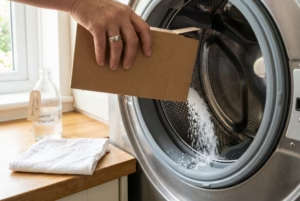
Used occasionally, apple cider vinegar can deodorise a washing machine drawer or drum. It helps remove detergent residue and neutralise smells.
Inside a paragraph, professionals advise:
- pouring 200 ml into the detergent drawer,
- running a hot empty cycle,
- alternating with white vinegar for descaling.
Do not overuse it. Frequent acidic cycles may weaken seals over time.
Can you use apple cider vinegar instead of white vinegar to clean a washing machine?
Organic apple cider vinegar works perfectly as a substitute when white vinegar runs out. Both share the same acidic properties needed to tackle limescale and soap residue buildup. The key difference lies in cost and potential staining risk.
White vinegar remains the preferred choice for machine maintenance because of its clear colour and lower price point. Apple cider vinegar’s amber tint poses minimal risk to internal components, though it costs considerably more for the same cleaning results.
When substituting, use the same quantities you would with white vinegar. Pour 200ml into an empty machine and run a hot cycle. The natural acids will break down mineral deposits just as effectively, leaving your appliance fresh and functioning smoothly.
FAQ
Is apple cider vinegar effective as a disinfectant?
Apple cider vinegar has mild antibacterial properties but does not disinfect to professional standards. Use it for cleaning, not sanitising.
Can apple cider vinegar replace commercial products?
It can replace some commercial products for light cleaning and deodorising, but not specialised descalers or disinfectants.
Does apple cider vinegar leave residue?
Yes, more than white vinegar. Always wipe with a damp cloth if streaks appear.
Can I mix apple cider vinegar with essential oils?
Yes, for fragrance only. Essential oils do not increase cleaning power.
Is apple cider vinegar better than white vinegar for daily cleaning?
For smell and gentleness, yes. For performance, no.
Why is apple cider vinegar good for cleaning?
Apple cider vinegar owes its cleaning power to acetic acid, which creates an environment hostile to bacteria and grime. This acid content allows it to cut through grease effectively while neutralizing alkaline odours that linger in kitchens and bathrooms.