Summarise this article with:
 ChatGPT
 Mistral
 Claude
 Perplexity
 Grok
Grok
Baking soda and vinegar are often presented as a universal, almost magical cleaning duo. They are inexpensive, easy to find, and feel reassuringly “natural”, which explains why baking soda and vinegar cleaning is one of the most searched home-cleaning topics in the UK. In reality, their effectiveness depends entirely on how they are used, where they are applied, and—most importantly—whether they are mixed or kept separate.
Used correctly, baking soda and vinegar can make everyday cleaning jobs easier and reduce reliance on harsh cleaners. Used incorrectly, they cancel each other out, leave residue behind, or create a lot of fizz with very little cleaning power. This guide explains how these products actually behave, when they are useful, and when they are simply not the right tool for the job.
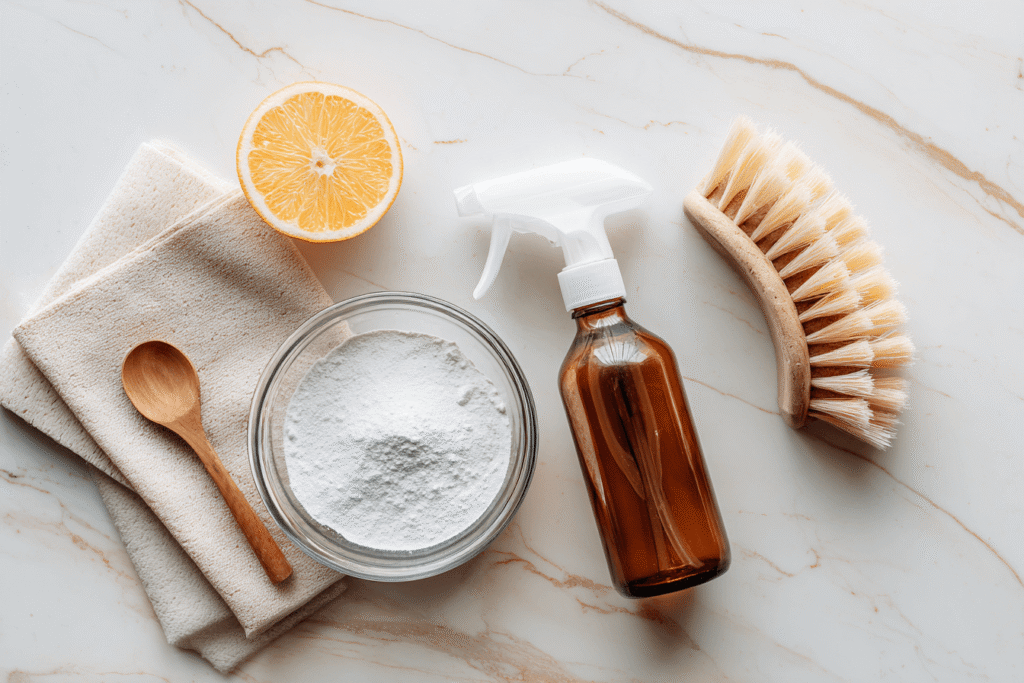
Using baking soda and vinegar for cleaning
Before looking at specific areas of the home, it helps to understand what each product does on its own. First of all, you’re probably wondering if baking soda is the same as bicarbonate of soda. The answer is yes.
Baking soda, or sodium bicarbonate, is a mild alkali with gentle abrasiveness. It lifts greasy spots, absorbs odours and helps loosen dirt without scratching most surfaces. Vinegar, especially white vinegar or white wine vinegar for cleaning, is acidic. It dissolves limescale, soap scum and mineral deposits, particularly those caused by hard water.
The problem begins when they are mixed indiscriminately. When baking soda and vinegar are combined, they trigger a chemical reaction that produces carbon dioxide, water and sodium acetate. The fizz looks impressive, but the cleaning power is short-lived. In most cases, it is more effective to use them separately, one after the other, depending on what you are trying to remove.
Vinegar and bicarbonate soda: should you mix them?
The idea of vinegar and bicarbonate soda working better together is widespread, but misleading. Once mixed, neither product retains its original strength. That does not mean mixing is always useless, but it does mean expectations should be realistic.
Mixing baking soda and vinegar can be helpful when:
- you want a short-lived foaming action to help lift loose debris
- the goal is mechanical movement rather than chemical cleaning
- the surface can be rinsed thoroughly afterwards
For most cleaning tasks, however, alternating them—rather than mixing—delivers better results and avoids baking soda residue being left behind.
Is baking soda or vinegar better for cleaning?
This question comes up constantly: is baking soda or vinegar better for cleaning? The answer depends entirely on the type of dirt involved.
Baking soda cleaning works best on:
- greasy spots
- bad odours
- grime that needs gentle abrasion
Vinegar performs best on:
- hard water stains
- limescale
- soap residue
Neither product is better in absolute terms. They simply solve different problems, which is why understanding the surface and soil type matters more than choosing one “winner”.
Baking soda cleaner: where it shines
A bicarbonate soda cleaner works particularly well on interior surfaces that collect grease, residue or smells rather than mineral deposits. Because of the abrasiveness of the baking, it can scrub without scratching when used correctly.
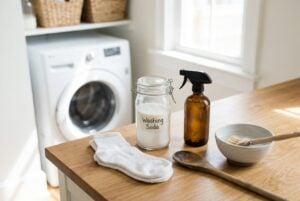
Used as a baking soda paste, it clings to surfaces instead of running off, which makes it especially useful for ovens, hobs and grout. The paste is typically made in a small bowl, mixed with just enough water to hold together, and applied with a damp cloth.
Cleaning oven with baking soda and vinegar
Cleaning oven with baking soda and vinegar is one of the most effective applications—when done in the right order. Baking soda handles burnt-on grease; vinegar is only useful at the end to remove residue.
The effective method looks like this:
- apply baking soda paste to greasy interior surfaces
- leave it to work for several hours or overnight
- wipe away loosened grime
- spray diluted white vinegar to remove remaining residue
Used this way, cleaning an oven with baking soda becomes a little easier without resorting to harsh cleaners, especially around stubborn elbow grease areas.
Homemade oven cleaner
A homemade oven cleaner based on baking soda works because it stays in contact with grease long enough to soften it. This matters around the heating element, where grease is repeatedly baked on and becomes brittle rather than sticky.
Vinegar does not dissolve baked grease. Its role is finishing, not cleaning. Mixing both at once reduces effectiveness and creates unnecessary mess.
Cleaning washing machine with baking soda
Cleaning washing machine with baking soda targets odours, detergent build-up and residue rather than visible dirt. Baking soda helps neutralise smells and soften residue inside the drum.
For best results:
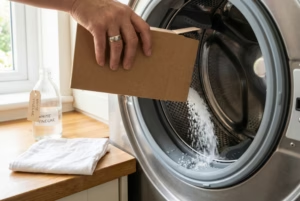
- add a cup of baking soda directly to the drum
- run a hot empty cycle
- wipe seals and door edges afterwards
This works particularly well when combined with vinegar in a separate cycle, poured into the detergent drawer, to tackle limescale.
Cleaning dishwasher with baking soda and vinegar
Cleaning dishwasher with baking soda and vinegar follows the same logic as washing machines. Vinegar addresses mineral build-up; baking soda neutralises odours.
Never mix them in the same cycle. Run vinegar first, then baking soda in a separate short wash to avoid neutralising both products prematurely.
Vinegar soda cleaner for bathrooms and toilets
A vinegar soda cleaner is often suggested for toilets, but again, sequence matters. Cleaning toilet with baking soda and vinegar works best when baking soda is used for scrubbing and vinegar for finishing.
Baking soda helps scrub interior surfaces without scratching porcelain. Vinegar helps remove hard water stains once grime has been loosened. A toilet brush is more effective than foam alone, which often looks busy but does little real cleaning.
Vinegar water cleaner for everyday surfaces
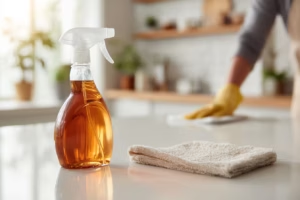
A vinegar water cleaner—usually diluted white vinegar in a spray bottle—is ideal for wiping non-porous interior surfaces. It cuts through soap residue and light grease, especially in kitchens and bathrooms.
Avoid using vinegar on natural stone, as acid damages these surfaces permanently.
Baking soda stain removal
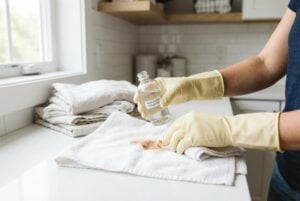
While not its primary role, baking soda stain remover works well on greasy spots and odours embedded in fabrics. Used dry, it absorbs oils; used as a paste, it loosens residue.
It is not effective on everything, and it does not replace targeted stain removers, but it remains useful as part of broader homemade cleaning products.
Mixing baking soda and vinegar: when it helps, when it doesn’t
Mixing baking soda and vinegar only makes sense when the goal is physical movement rather than chemical cleaning. The fizz can help dislodge loose debris, but it does not clean in depth.
In most effective ways of cleaning, separation—not mixing—is what delivers results.
Bread soda and vinegar cleaning myths
Many believe the impressive fizzing reaction proves these ingredients work harder together than apart. This misconception stems from assuming visible bubbles equal superior cleaning power. The reality proves quite different.
People usually expect this combination to tackle everything from stubborn grease to mineral deposits. What actually happens is the creation of essentially salt water once the reaction settles. The brief mechanical action might dislodge loose debris, but deep-seated grime remains untouched.
Another persistent myth suggests this mixture can replace commercial cleaning solutions entirely. While both ingredients excel individually, their combined form lacks the concentrated effectiveness needed for challenging tasks. Testing any cleaning solution on an inconspicuous area first remains wise practice, whether using natural or commercial products.
White vinegar and baking soda: safe use summary
Used sensibly, white vinegar and baking soda reduce reliance on stronger products and make routine cleaning jobs more manageable. Used incorrectly, they waste time and effort.
Summary table: when to use what
| Cleaning task | Baking soda | Vinegar |
|---|---|---|
| Greasy spots | ✔ Effective | ✖ Limited |
| Hard water stains | ✖ Limited | ✔ Effective |
| Oven cleaning | ✔ Main cleaner | ✔ Residue removal |
| Washing machine | ✔ Odours | ✔ Limescale |
| Toilet cleaning | ✔ Scrubbing | ✔ Descaling |
FAQ
What does baking soda and vinegar do for cleaning?
They address different problems: baking soda absorbs and loosens, vinegar dissolves mineral residue. Together, they only fizz briefly.
How do you use bicarbonate of soda for cleaning?
As a paste for scrubbing, dry for odours, or added to appliances for residue control.
Baking powder or baking soda ?
You’re probably wondering what’s the difference between baking powder and baking soda. Baking soda is a mild abrasive and deodorizer used to scrub and neutralize odors, while baking powder is basically useless because its cleaning effect comes from baking soda but is diluted with fillers and acids.
How do you use soda powder or baking powder for cleaning?
Baking powder is not suitable. Always use baking soda for cleaning tasks.